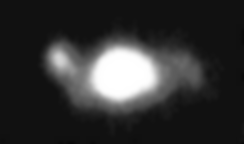
 Narrow band optical image of TON 202 with bandwidth 30 Angstroms centered at 1.38 microns in the infrared.
Image is 10 arcseconds high.
(Stockton, 1987)
Narrow band optical image of TON 202 with bandwidth 30 Angstroms centered at 1.38 microns in the infrared.
Image is 10 arcseconds high.
(Stockton, 1987)
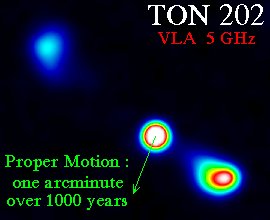 Quasar TON 202 :
Pseudo-color radio map observed by the VLA at 5 GHz, proper motion of core is perpendicular to the jet
axis. The radio lobes are comparable to
GRS 1915+105,
GRO J1655-40,
Cygnus-A,
SS433 and Cyg X-3.
Quasar TON 202 :
Pseudo-color radio map observed by the VLA at 5 GHz, proper motion of core is perpendicular to the jet
axis. The radio lobes are comparable to
GRS 1915+105,
GRO J1655-40,
Cygnus-A,
SS433 and Cyg X-3.We have searched the proper motion catalog of 951 faint blue stars measured by Luyten (1969) for quasars in the recent Hewitt and Burbidge (1993) catalog. We found 40 quasars with the same name, position and magnitude as the star given in Luyten (1969). We have successfully reproduced the results of Varshni (1982) except for PHL 1070, and have obtained 10 additional quasar proper motions to add to the previous list of 30.
One of them, TON 202, is not only the second fastest quasar in our list, but
has the largest apparent magnitude (V=15.63). It ranks among the top 1 % in
order of apparent luminosity. ( over 7000 quasars are fainter than TON 202 )
It is travelling across the sky at a phenomenal speed of 5 arcseconds per
century, about the same motion as NGC 7293.
Narrow band optical image of TON 202 with bandwidth 30 Angstroms centered at 1.38 microns in the infrared.
Image is 10 arcseconds high.
(Stockton, 1987)
NGC 7293 (Helix) is one of the nearest and brightest of the planetary nebula. Its central star has roughly the same magnitude of proper motion as quasar TON 202. It is no coincidence that one of the fastest moving quasars is also one of the brightest. We come to the inescapable conclusion that quasars are stars within our galaxy, and those with proper motions greater than 40 milliarcseconds per year are within 1,000 light years from the sun.
Distribution of           Distribution of                              Count
quasars                   faint blue stars
                    8.5 *                                                 3
       Each *       9.0 ****                                              7
       symbol       9.5 **        Each * symbol represents                5
       represents  10.0 ********  two faint blue stars                   16
       one quasar  10.5 ********                                         16
                   11.0 ********                                         16
TOTAL=40 quasars   11.5 ***********************                          45
                   12.0 *****************************                    57
                   12.5 ************************************************ 97
Ratio of quasars   13.0 *****************************                    46
to faint blue      13.5 *****************************                    45
stars in magnitude 14.0 ***********************************              71
range :            14.5 ****************************                     55
   2 %           * 15.0 ***********************                          50
                   15.5 ********************************                 65
   4 %         *** 16.0 **************************************           75
   9 %     ******* 16.5 ***************************************          77
   7 %        **** 17.0 ****************************                     56
   9 %       ***** 17.5 ****************************                     55
  21 %   ********* 18.0 *********************                            41
  27 %  ********** 18.5 ******************                               37
                   19.0 *****                         TOTAL = 951 stars   9
i.e. One in every four very faint blue stars in Luyten (1969) is a quasar.
Vt = 760, 1000, 5200 and 2300 times the speed of light !
for PHL 1033, TON 202, LB 8956 and LB 8991 respectively. Needless to say these values are without physical significance and clearly indicate that the cosmological red shift hypothesis is completely untenable.
 Laser Stars Home
